Explain it out loud. See what you don't know.
The Feynman technique is a way to learn something by explaining it in plain words, as if to someone who has never met the subject. Where your explanation stalls or turns vague, you have found a gap; you go back to the source, fill it, and explain again. It works best spoken aloud, and TalkGraph lets you do exactly that: you talk, it maps what you said, and the gaps show up as open questions.
By TalkGraph · Updated
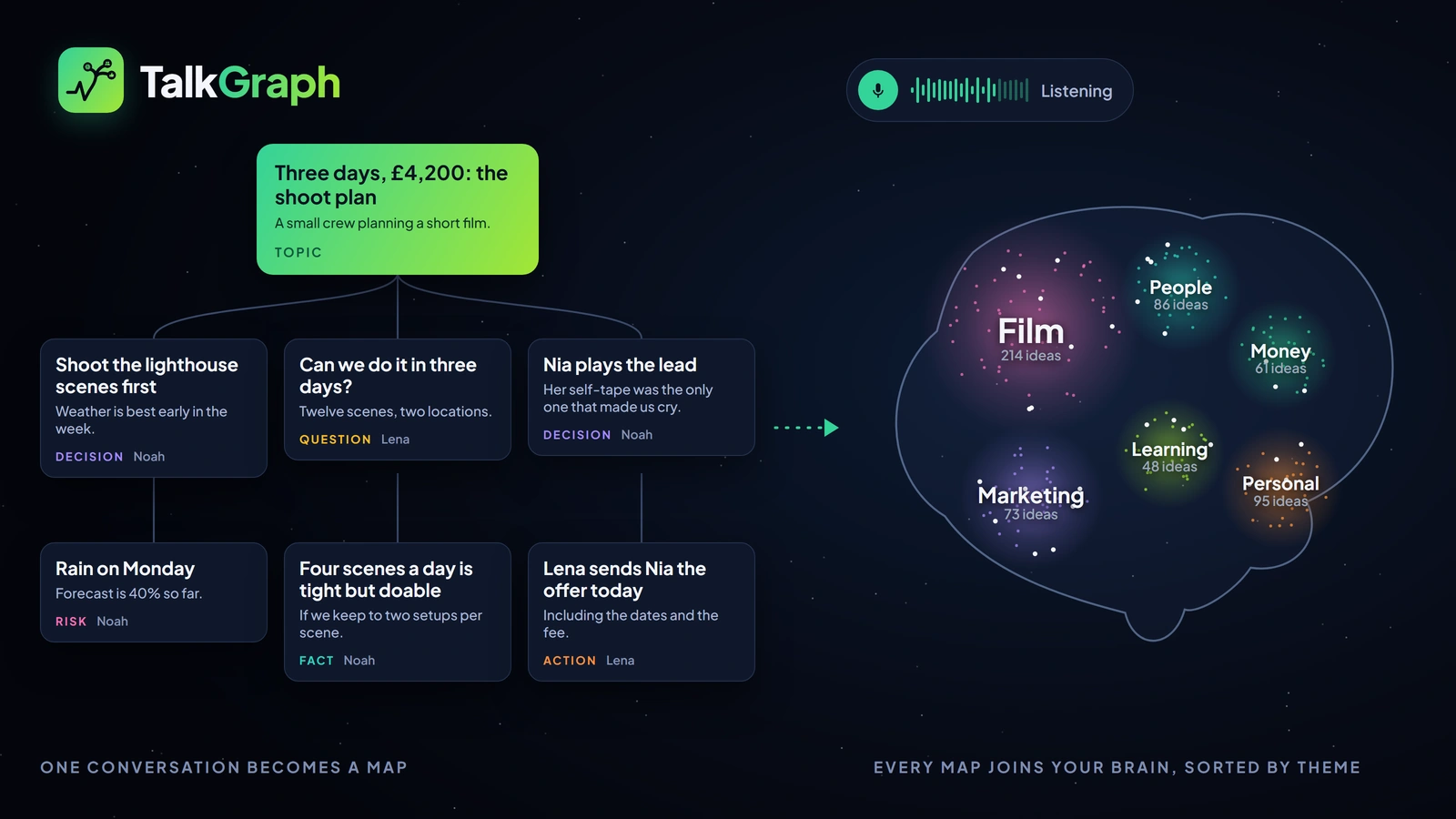
The four steps
The method is named after the physicist Richard Feynman, who was known for explaining hard ideas in everyday language and for distrusting knowledge that was only a name for something. The four steps are a later summary of that habit, not a procedure he wrote down.
- Pick one concept. Narrow is better: "how a vaccine trains the immune system", not "immunology".
- Explain it in plain words, from memory, as if to a twelve-year-old. No notes, no jargon you could not define.
- Notice where you got stuck, skipped a step or reached for a technical word to cover a hole. Those are the gaps. Go back to the book, lecture or paper and fix each one.
- Explain it again, shorter and simpler, with an example or comparison of your own. Repeat until it runs without a stumble.
Why saying it aloud beats re-reading
Re-reading feels productive because the page looks familiar. Familiar is not the same as understood, and you only find the difference when you have to produce the explanation yourself.
Three findings sit behind the technique. Students asked to explain a text to themselves as they read understood it better than students who read it twice (Chi and colleagues, 1994). People who taught material to others remembered and applied it better a week later than people who only studied it (Fiorella and Mayer, 2013). And pulling something out of memory strengthens it more than studying it again (Roediger and Karpicke, 2006).
None of these studies tested "the Feynman technique" under that name. They tested its parts: explaining, teaching and recalling.
How to do it with TalkGraph
TalkGraph does not judge whether your explanation is correct, and it does not find gaps you did not voice. It gives you a clear picture of what you said, asks you questions, and keeps the open ones in front of you. Checking the facts against the source is still your job.
You can try the first four steps with no account: one map of about 25 nodes, and nothing is saved. Saving maps, a second explanation and the Brain need a free account.
- Open TalkGraph and press record. Close your notes.
- Explain the concept aloud from start to finish. When you do not know something, say so: "I'm not sure why the second dose matters". That lands on the map as a question.
- Look at the map. The parts you explained well are connected nodes. The parts you were unsure of are question nodes, and a thin branch is a part you rushed.
- Press "Ask me" (on a phone it is "Ask me a question" in the menu). TalkGraph asks one about what you just said, the way a curious listener would. Answer it aloud.
- Go back to your source for each open question, then record a second, shorter explanation. With a free account both maps are saved and join your Brain.
An AI that asks you questions →How speech becomes a map →The longer read: the Feynman technique, done out loud →
A worked example
Topic: why the sky is blue. First attempt, aloud: "Sunlight is white, which is all the colours mixed. When it hits the air it scatters. Blue scatters more than red, so blue comes at you from every direction. I'm not sure why blue scatters more. And I don't know why the sky isn't violet, since violet is further along than blue."
On the map that is three connected ideas and two questions. The questions are the work: shorter wavelengths scatter far more strongly off air molecules, and the sky is not violet because the sun gives out less violet, the upper air absorbs some of it and our eyes are less sensitive to it.
Second attempt: "Air scatters short wavelengths much more than long ones. Blue is short, so it bounces around the sky and reaches your eye from everywhere. Violet is shorter still, but there is less of it and we see it poorly." Shorter, no stumbles, and the two questions are closed.
Keep it after you have learned it
Understanding fades if it is never used. With a free account, every explanation you record joins your Brain, and the Brain's Workout shows you an idea you have talked about and asks you to recall it before it shows what you said. It is the recall step of the technique, on your own words, without making flashcards.
Questions people ask
What is the Feynman technique in simple terms?
Learn something by explaining it in plain words to an imaginary beginner. Where you get stuck, you have found what you do not understand. Fix that from the source and explain again.
What are the four steps of the Feynman technique?
Choose a concept. Explain it simply from memory. Find the gaps and go back to the source. Simplify and explain again, with your own example.
Is there an app for the Feynman technique?
You only need a voice and something to capture it. TalkGraph is built for the spoken version: you explain aloud, it turns what you said into a map, your uncertainties become open questions, and it asks you a question back. You can try it with no account (one map of about 25 nodes, nothing saved); saving maps and the Brain need a free account.
Does the Feynman technique actually work?
Its parts are well supported: explaining to yourself, teaching others and recalling from memory each improve understanding and retention in controlled studies. The named four-step technique has not been tested as a package, so treat the steps as a useful habit, not a proven formula.
Should I write it or say it?
Either works. Speaking is faster and makes it harder to hide a gap behind tidy wording. Writing is easier to check afterwards. Recording yourself and reading the map back gives you both.
Does TalkGraph tell me if my explanation is wrong?
No. It maps what you said, asks you questions and keeps your open questions visible. It does not mark your explanation against a textbook, so check the facts against your source.
Sources
- Chi, M. T. H., De Leeuw, N., Chiu, M.-H. & LaVancher, C. (1994). Eliciting self-explanations improves understanding. Cognitive Science 18(3). doi.org/10.1207/s15516709cog1803_3
- Fiorella, L. & Mayer, R. E. (2013). The relative benefits of learning by teaching and teaching expectancy. Contemporary Educational Psychology 38(4). doi.org/10.1016/j.cedpsych.2013.06.001
- Roediger, H. L. & Karpicke, J. D. (2006). Test-enhanced learning: Taking memory tests improves long-term retention. Psychological Science 17(3). doi.org/10.1111/j.1467-9280.2006.01693.x
Checked against the papers on . Research moves fast; follow the links for the latest versions.
Related
An AI thinking partner →Voice brain dump →AI and your brain →Voice to mind map →Thinking out loud →