Every interview makes the next one smarter.
User research, journalism, hiring, discovery calls: interviews generate insights that die in separate documents. TalkGraph maps each interview as a knowledge graph and connects them all in one Brain, so patterns across conversations surface themselves.

The problem with interview analysis
The standard workflow is brutal: record, transcribe, highlight, code, synthesise, days of manual work per study. And because each transcript is its own silo, cross-interview patterns depend on the analyst's memory. The fifth interview never knows what the first four said.
Worse, the evidence chain breaks. A theme in your synthesis deck can't point back to the exact claim, in the exact interview, from the exact person. Stakeholders challenge findings, and you're scrubbing through timestamps.
How it works
- 1Map it live or retroactively
Capture the interview from your browser as it happens, or import existing transcripts (VTT, TXT, PDF). Speaker diarization separates interviewer from participant automatically.
- 2Claims become cards
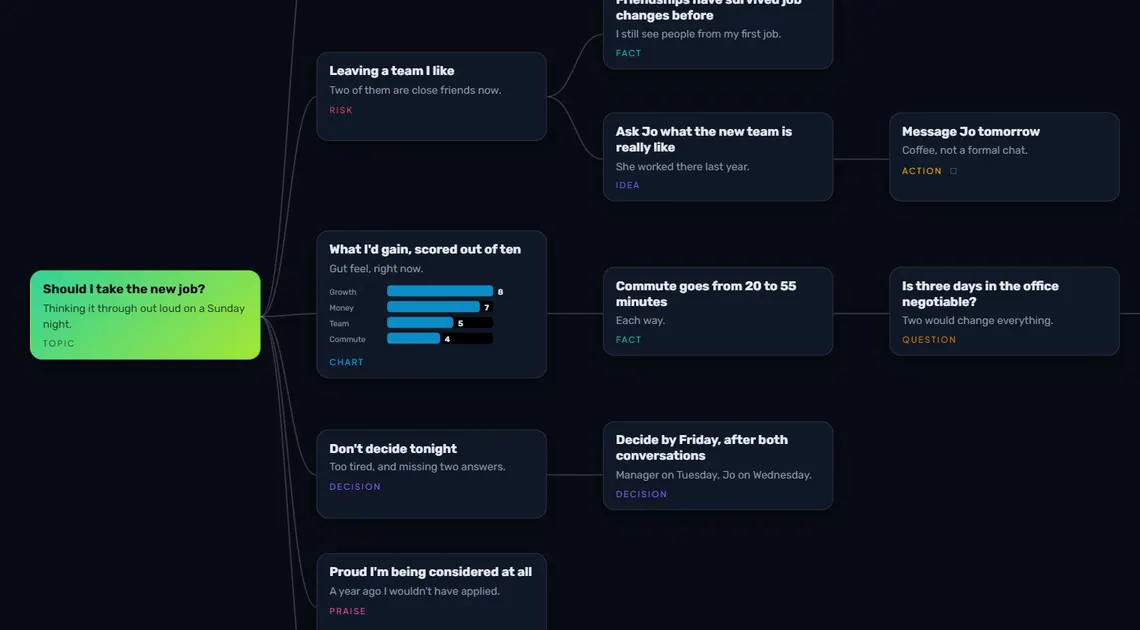
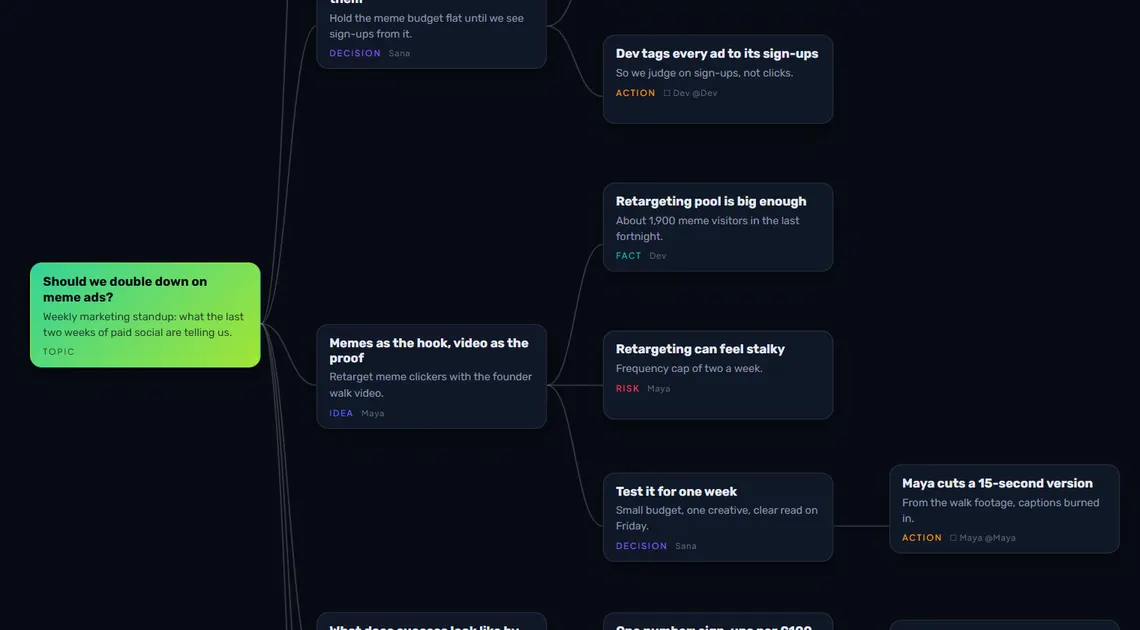
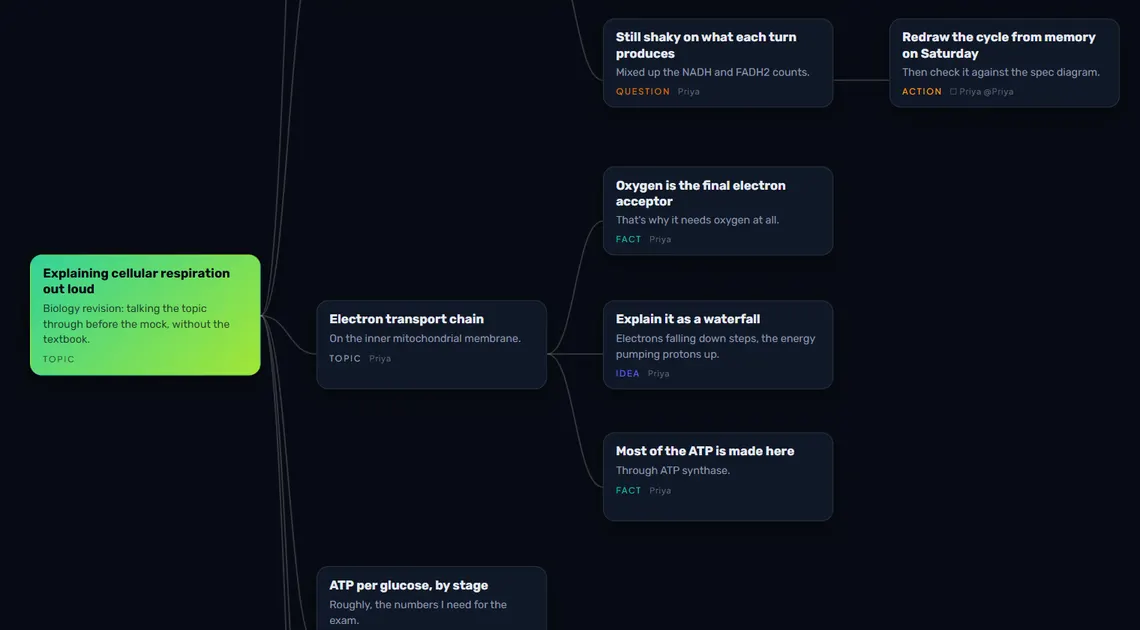
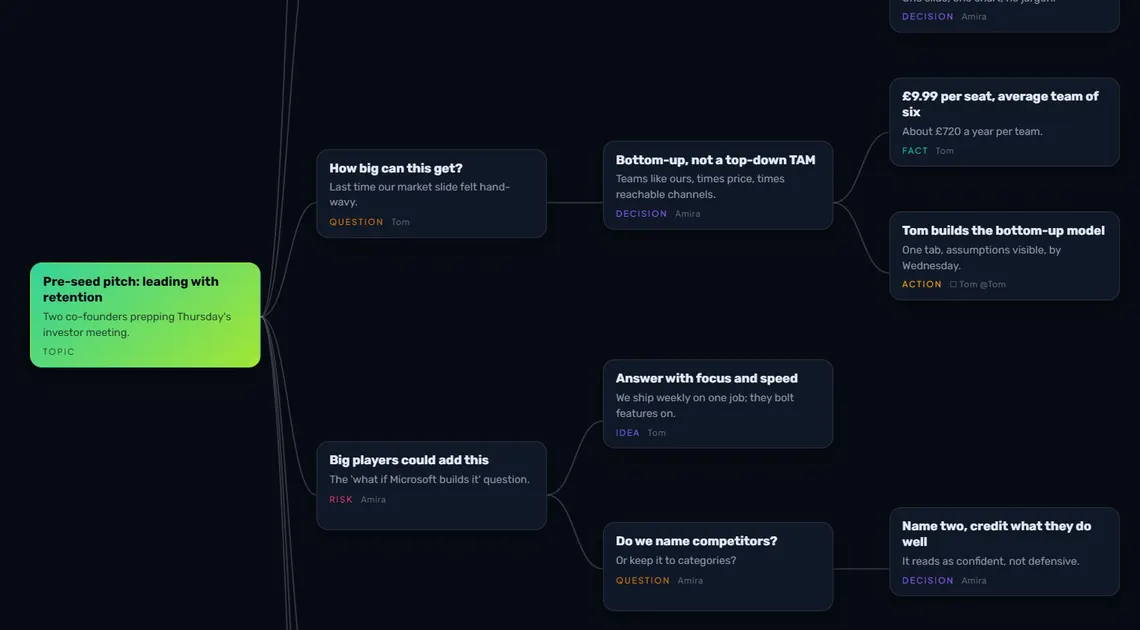
Statements distil into typed, attributed cards (facts, ideas, questions, risks), connected into a navigable graph instead of a scroll of text.
- 3Ask the map
Query the interview in plain language: "what concerns came up about pricing?" Answers reference the actual cards, never invented content.
- 4Synthesise across interviews
Each interview commits to your Brain. Shared concepts across interviews strengthen into synapses: the cross-cutting themes, visible at a glance, each traceable to its sources.
Built for people who talk to people
The Brain indexes every interview's concepts canonically. When three separate participants mention the same pain, it strengthens into one reinforced node. Themes emerge from evidence, not recall.
Every card keeps its speaker. Your synthesis can always answer "who said this?" Participant attribution is infrastructure, not an annotation.
Insights live as cards linked to their interview graph. Trace any theme back to the exact conversation and the exact claim it came from.
Plain-language questions over the map and transcript replace timestamp-scrubbing. "What did participants say about onboarding?" gets an answer, grounded in the material.
Drag, branch, merge and expand cards. The AI proposes structure; the researcher keeps judgement. Your analysis, your call.
Send stakeholders a live read-only link to the interview graph, and they explore the evidence themselves instead of reading your summary of it.
Frequently asked questions
Is this qualitative coding software?
It's adjacent but different: instead of manually tagging transcripts, TalkGraph structures the conversation into a typed knowledge graph as it's spoken (or from a transcript), then connects concepts across interviews automatically. You keep editorial control: the map is fully editable.
Can I import interviews I already recorded?
Yes. VTT, TXT and PDF imports are supported, so existing transcript archives map retroactively and join the same cross-interview Brain.
How does cross-interview synthesis work?
Each interview commits its concepts to your Brain under canonical names. Concepts that reappear across interviews strengthen into synapses, so recurring themes literally stand out in the constellation, each one traceable to its source interviews.
What about participant confidentiality?
Interviews are private by default. Sharing is opt-in via rotating read-only links you can kill at any time, and TalkGraph never makes your data public.
More answers in the TalkGraph FAQ. Why we built it: the problem with AI notes. How it compares: TalkGraph vs Otter.ai, TalkGraph vs Granola, TalkGraph vs NoteGPT, TalkGraph vs Mapify, TalkGraph vs Voicenotes, TalkGraph vs Evernote, TalkGraph vs OneNote, TalkGraph vs Google Keep, TalkGraph vs Apple Notes, TalkGraph vs ChatGPT.
More use cases
Say it out loud. Map it now.
Free to start, no card needed.
Map your first interview