Think out loud. See what you actually think.
Your best thinking happens mid-sentence - and then it evaporates. TalkGraph draws your thoughts as you speak them: the plan, the doubt, the open question, all as connected structure you can look at, rearrange and come back to.

The problem with thinking in your head
Working memory holds a handful of things at once. A real problem - a career move, a difficult conversation, a plan with trade-offs - has more moving parts than that, so your mind loops: the same three worries, over and over, never all visible at the same time.
Writing it down helps, but typing is slow and linear, and a page of notes hides the structure. Speech is the fastest interface you have to your own mind - it just never left a record worth keeping. That's the gap TalkGraph closes.
How it works
- 1Just start talking
No prompts, no format. Ramble. Contradict yourself. Circle back. TalkGraph structures the meaningful points while you speak - hedged thoughts land as faded drafts until you commit to them.
- 2See the shape of the problem
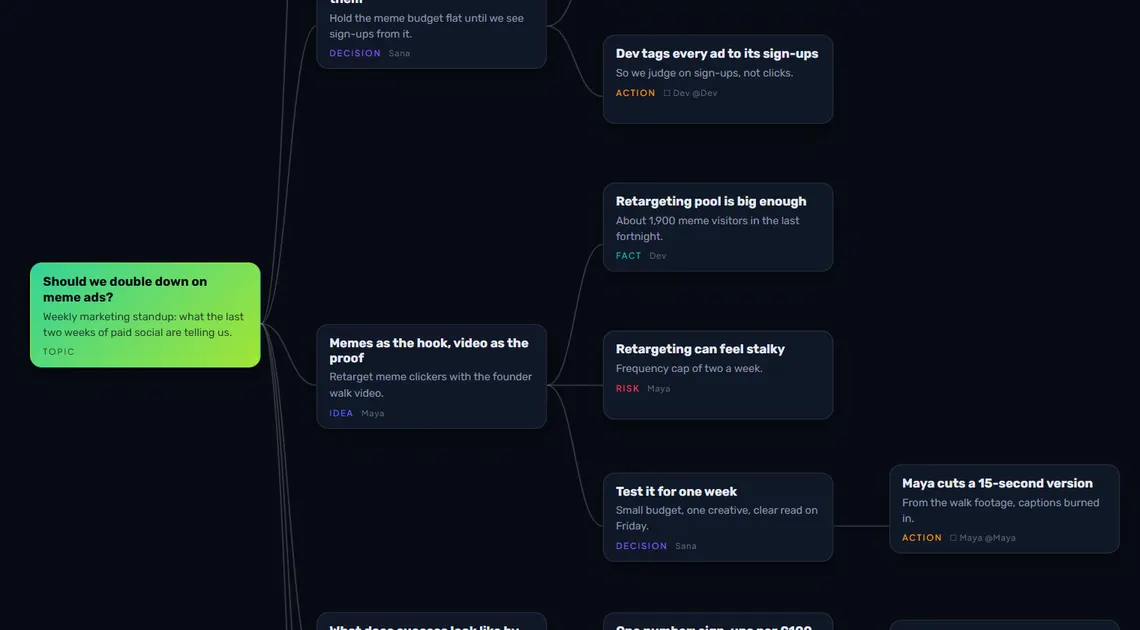
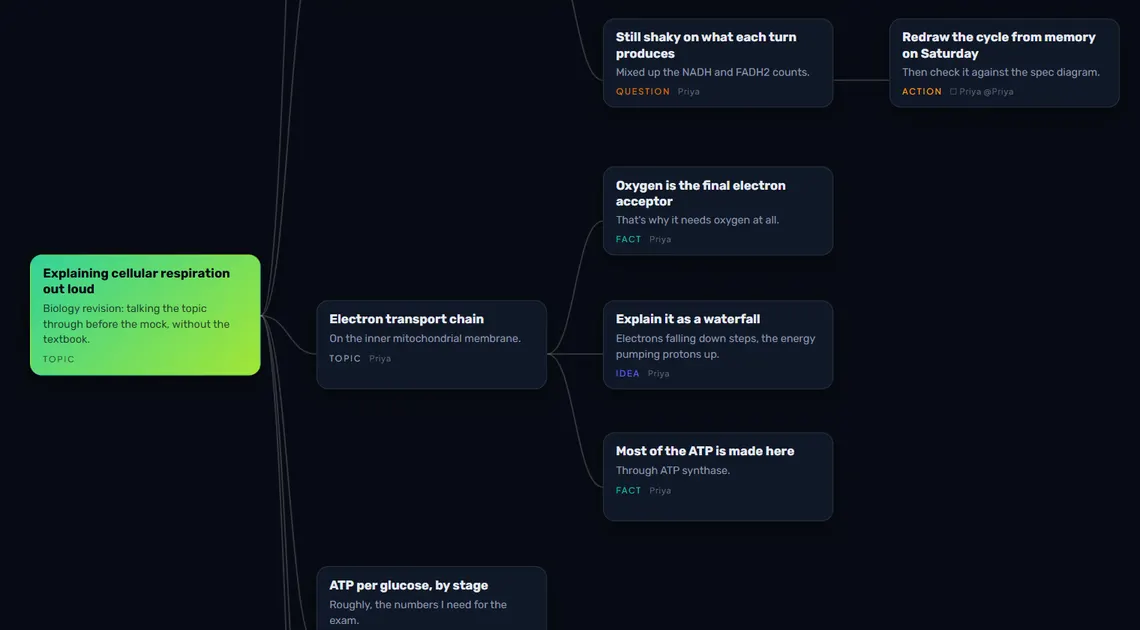
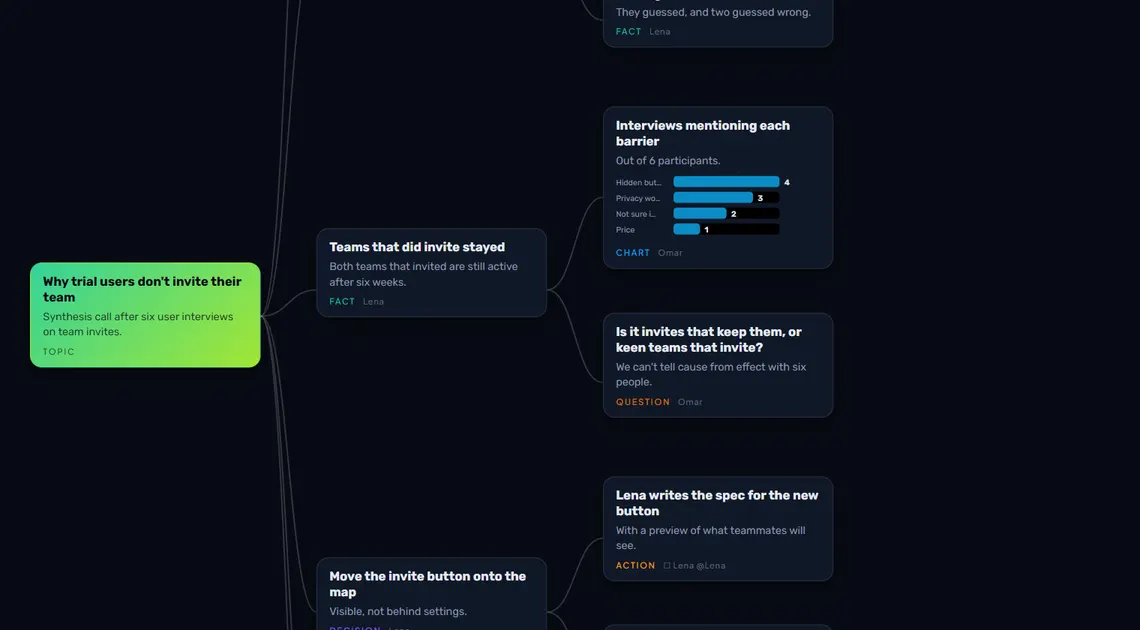
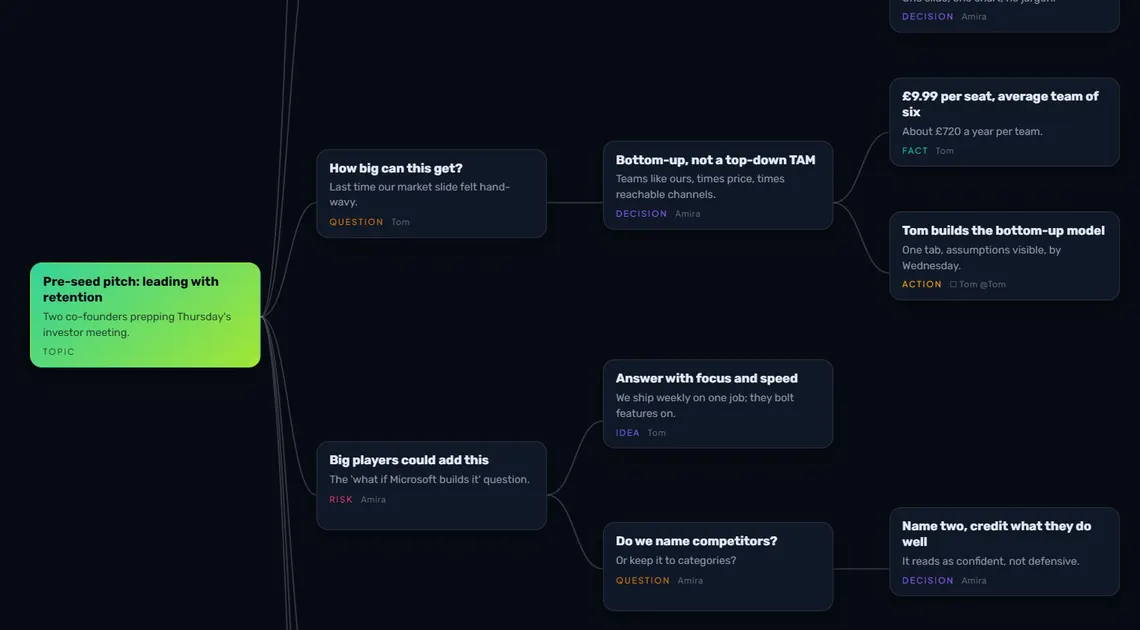
The loop in your head becomes branches on a map: options, risks, facts, open questions. Seeing it is usually the moment it stops feeling unmanageable.
- 3Push on it
Expand any branch for options and risks you haven't considered. A pause triggers one Socratic question - the kind a good thinking partner would ask, never an answer forced on you.
- 4Come back to it
Every session feeds your Brain. Next week's version of the problem starts from this week's thinking - the decision you're circling connects to every conversation that shaped it.
Built for a mind at work
Say "maybe I should…" and the card lands dashed and faded. Commit out loud and it settles solid. The map distinguishes what you're considering from what you've decided - because that distinction is the whole job.
The unresolved parts of your thinking become question cards automatically - a list of exactly what you don't know yet, collected while you talked.
TalkGraph structures and expands your ideas - it never writes them for you. The Socratic layer asks one short question when you stall; the thinking stays yours.
Thinking out loud requires honesty, and honesty requires privacy. Sessions are yours alone: private by default, encrypted in transit and at rest, and yours to export or delete at any time.
Journal by voice and every entry joins one growing map of your own mind - searchable, connected, and visibly strengthening where your life keeps returning to the same themes.
Weeks later, ask your Brain "what did I decide about the move?" and get the answer with links to the exact cards - your reasoning, retrievable.
Frequently asked questions
I don't know what to say - does that matter?
No. Start anywhere: "here's what's bothering me." Hedges, tangents and half-thoughts are expected input - the structure emerges from the mess; you don't have to arrive with it.
Is this journaling?
It can be, but it's more general: planning, decisions, brainstorming, working through a problem. Journaling is one mode of a bigger thing - thinking with a record.
Is my thinking private?
Completely. Boards are private by default, encrypted in transit and at rest, and nothing is public unless you explicitly share it. You can export or delete everything at any time, and the full detail is on our security page.
How is this better than voice notes?
A voice memo is a recording you'll never re-listen to. TalkGraph leaves you a structured, editable map - and every session compounds into a Brain you can ask questions later.
More answers in the TalkGraph FAQ. Why we built it: the problem with AI notes. How it compares: TalkGraph vs Otter.ai, TalkGraph vs Granola, TalkGraph vs NoteGPT, TalkGraph vs Mapify, TalkGraph vs Voicenotes, TalkGraph vs Evernote, TalkGraph vs OneNote, TalkGraph vs Google Keep, TalkGraph vs Apple Notes, TalkGraph vs ChatGPT.
More use cases
Say it out loud. Map it now.
Free to start, no card needed.
Start thinking out loud