How to remember conversations better (and what people actually said)
Decide what you need to keep, listen for it, say it back in your own words, and recap it out loud in the two minutes after the conversation ends. Forgetting is fastest soon after you hear something, so a short recap straight away is the cheapest way to keep it.
You leave a call sure you'll remember it. By the evening you know it went well, roughly what was agreed and that someone mentioned a date. By next week you're not sure whose idea it was, or whether the date was the 14th or the 24th. That isn't a bad memory. It's an ordinary one, doing what memory does with talk.
Why conversations slip away
Three things work against you. First, your attention is split: while someone is talking you're also working out what to say next. In a 1973 study, people taking turns to read words aloud in a group remembered fewer of the words read just before and after their own turn, a pattern now called the next-in-line effect. Planning your reply crowds out the thing you're replying to.
Second, nothing gets rehearsed. A conversation moves on, and each point is heard once. Things you hear once and never bring back to mind fade quickly.
Third, memory keeps the meaning, not the words. In a classic 1967 experiment, Jacqueline Sachs had people listen to passages and then spot changes to a sentence they'd heard. Changes in meaning were easy to notice. Changes in wording that kept the meaning went unnoticed after only a few more sentences of listening. That's useful most of the time, but it's why "I'm sure she said Friday" is so often wrong.
If forgetting conversations is new for you, or it's getting worse or worrying you, talk to a doctor. The habits below are for the everyday kind.
Before: decide what you need to keep
You can't keep everything, so choose. For most conversations it's four things: names, numbers and dates, what was decided, and who promised what. If you know that going in, you'll notice them as they come up.
During: five habits
1. Listen for the four things
Names, numbers and dates, decisions, promises. When one comes up, give it a moment of attention before you think about your reply.
2. Say it back in your own words
"So the budget's fixed at forty, and the start date can move?" Paraphrasing checks you heard it right, and putting it into your own words makes you work with the idea rather than just hear it. It also catches misunderstandings while the other person is still there.
3. Ask one clarifying question
"When you say soon, do you mean this month?" A question makes you process the answer rather than just hear it, and vague words are where most later disagreements start.
4. Jot keywords, not sentences
If you can take notes, write single words or numbers: "£40k", "Sam, deck, Fri". Writing full sentences pulls your attention out of the conversation; a few keywords are enough to bring the rest back later.
5. Use their name early
Say a new name back once in the first minute, and connect it to something they said. Names slip easily, and using one early gives it a second chance to stick.
Right after: the two-minute recap
This is the habit that does most of the work. Before you open your email or start the next thing, say out loud what you'll need later: what was decided, what you promised, what they promised, and anything still open. Two minutes is enough.
It works for two reasons. Pulling something back out of memory, rather than hearing it again, is what makes it last; testing beats rereading in study after study. And saying things out loud gives them a small memory boost of their own. A recap does both, at the moment you still have most of the conversation to work with.
Active recall: why testing yourself beats rereading →Does talking out loud actually help you think? →Debrief a client meeting in two minutes →
Later: bring it back once or twice
If it matters, look at your recap again a couple of days later, and once more after a week or so. Some people use a 2-7-30 rule of thumb (review after two days, seven days and thirty days). The exact days matter less than the spacing: each time you recall something after a gap, it lasts longer. Try to remember the points before you look at your recap, not after.
Remembering exact words vs the gist
For most conversations the gist is what you need, and memory is good at it. Exact words matter for a small number of things: a price, a date, a commitment, a quote you'll repeat to someone else. Don't trust memory with those. Repeat them back during the conversation and write them down straight after.
When to write it down or record it
Write down anything you'd be embarrassed to get wrong, and anything someone else will act on. If you want to record a conversation, tell the people in it first; in many places, and in most workplaces, that's expected and sometimes required. A recording helps you check exact words, but on its own it's a file you'll rarely replay. The recap is what turns it into something you can use.
Cognitive offloading: what to hand to your tools, and what to keep →
Do the recap into TalkGraph
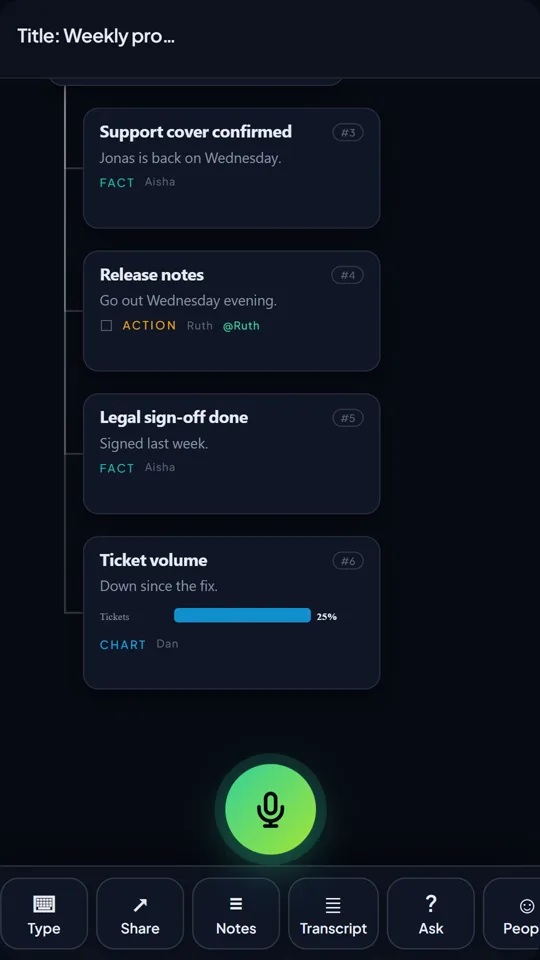
TalkGraph is a good place for the two-minute recap. Open it on your phone after the conversation and say what was agreed, what you owe and what's still open. It lands as a map: decisions, actions with their owner, and open questions, each on its own branch.
Every recap joins your Brain. Weeks later you can ask "what did Sam say about the budget?" and the answer comes from your own words and points to the map where you said them. It won't make you remember more, but it means you don't have to. If you'd rather capture the whole call, TalkGraph can map a conversation as it happens from your microphone, or from a browser tab on desktop Chrome and Edge, without adding a bot to the meeting.
After your next call, before you do anything else, say out loud for two minutes: what was decided, what you promised, what they promised, and what's still open. Check it against your memory in three days.
Questions people ask
Why do I struggle to remember conversations?
Usually because your attention is split between listening and planning what to say, and because each point is heard once and never brought back to mind. Memory also keeps the meaning rather than the exact words. If forgetting is new for you or worrying you, talk to a doctor.
How can I get better at remembering conversations?
Decide what you need to keep, say key points back in your own words during the conversation, and recap it out loud in the two minutes after. Then look at your recap again a few days later.
Why do I forget what someone said straight away?
Often because you were planning your reply while they were talking. Studies of turn-taking find people remember less of what was said just before and after their own turn.
What is the 2-7-30 rule for memory?
A rule of thumb for spacing reviews: go over something again after two days, seven days and thirty days. The research supports spacing in general rather than those exact days.
Should I record conversations to remember them?
A recording helps with exact words, but tell people first, and expect to rarely replay it. A short spoken recap is easier to use later.
TalkGraph maps what you say as you speak and asks you the next question. Free to try, no sign-up.

Klevis is the founder of TalkGraph, which he built and shipped solo. He has a First Class MSc in Computing and Information Systems, and writes about thinking, learning and tools that help people think rather than think for them.
LinkedIn →Sources
- Brenner, M. (1973). The next-in-line effect. Journal of Verbal Learning and Verbal Behavior, 12(3), 320-323. doi.org/10.1016/S0022-5371(73)80076-3
- Sachs, J. S. (1967). Recognition memory for syntactic and semantic aspects of connected discourse. Perception & Psychophysics, 2(9), 437-442. doi.org/10.3758/BF03208784
- Roediger, H. L. & Karpicke, J. D. (2006). Test-enhanced learning: Taking memory tests improves long-term retention. Psychological Science, 17(3), 249-255. doi.org/10.1111/j.1467-9280.2006.01693.x
- MacLeod, C. M. et al. (2010). The production effect: Delineation of a phenomenon. Journal of Experimental Psychology: Learning, Memory, and Cognition, 36(3), 671-685. doi.org/10.1037/a0018785