Active recall: why testing yourself beats rereading your notes
- Pulling information out of memory strengthens it more than reading it again.
- In one experiment, self-testers recalled about 61% after a week, against 40% for rereaders.
- Close the notes, say what you remember, then check the gaps.
Active recall means pulling something out of your memory rather than reading it again. It feels slower and harder than rereading, and that's why it works: the effort of retrieving something is what makes it stick.
Rereading has a lot going for it emotionally. It's calm, it's familiar, and by the third pass the material feels like yours. The trouble is that familiar and remembered aren't the same thing. Recognising a page is easy. Producing what's on it with the book closed is the skill you'll actually need in the exam, or the meeting.
The experiment that made the case
In 2006 Henry Roediger and Jeffrey Karpicke gave students short passages to learn. Some reread them, others took practice tests on them. Five minutes later the rereaders did slightly better, which is what most students would predict. A week later it had flipped: in one experiment the students who'd tested themselves recalled about 61% of the material, against about 40% for those who had only restudied.
How much of the passage students recalled a week later
Roediger & Karpicke (2006), Experiment 2, approximate figures. Five minutes after studying, rereading came out slightly ahead.
A large review in 2013, led by John Dunlosky, went through ten popular study techniques and rated how useful the evidence suggested each one was. Practice testing and spreading study out over time came top. Highlighting and rereading, which is probably what most of us actually do, were rated low, mainly because the evidence for them is thin. Explaining why something is true, and explaining material to yourself, came somewhere in the middle.
Doing it without making it a chore
You don't need flashcards, though they're fine. The simplest version is to close your notes and say out loud what you remember. Ask yourself why each point is true. Then open the notes and look at what you missed. The gaps are what you study next, and you come back in a few days and do it again.
Doing it out loud is faster than writing everything down, and saying things aloud gives a small memory boost of its own.
A one-week recall plan
Here's what spacing your recall looks like for one lecture or chapter. It takes about fifteen minutes in total, spread across a week.
- Same day: close the notes and say everything you remember for three minutes. Check, and mark what you missed.
- Two or three days later: answer a question for each main idea without looking. Check again, and focus on the misses.
- About a week later: explain the whole topic out loud, simply. Anything you still can't recall goes on next week's list.
Each round should feel a bit harder than rereading would. That effort is the point.
Recall, flashcards and practice papers
- Flashcards are recall for single facts: definitions, dates, vocabulary. Quick, and good for spacing.
- Practice papers are recall plus application: you retrieve what you know and use it on a new problem. Closest to the exam.
- Explaining out loud is recall for understanding: how ideas connect and why. Best for concepts and essay subjects.
Most subjects need a mix: flashcards for the facts, explanation for the ideas, practice papers before the exam.
Common mistakes
- Peeking too soon. Give yourself a proper attempt before you check, even if it's uncomfortable.
- Only recalling what's easy. The topics you avoid are the ones that need it most.
- Rereading everything afterwards. Check the misses, not the whole set of notes.
- Cramming all the recall into one night. The same amount of practice spread over days works better.
- Mistaking recognition for recall. Spotting the right answer in a list is easier than producing it.
It's not just for students
Anyone learning something new benefits: a new job's terminology, a language, the details of a product you're about to pitch. The method is the same. Try to produce it from memory, check, focus on the gaps, and come back to it a few days later.
Active recall with TalkGraph
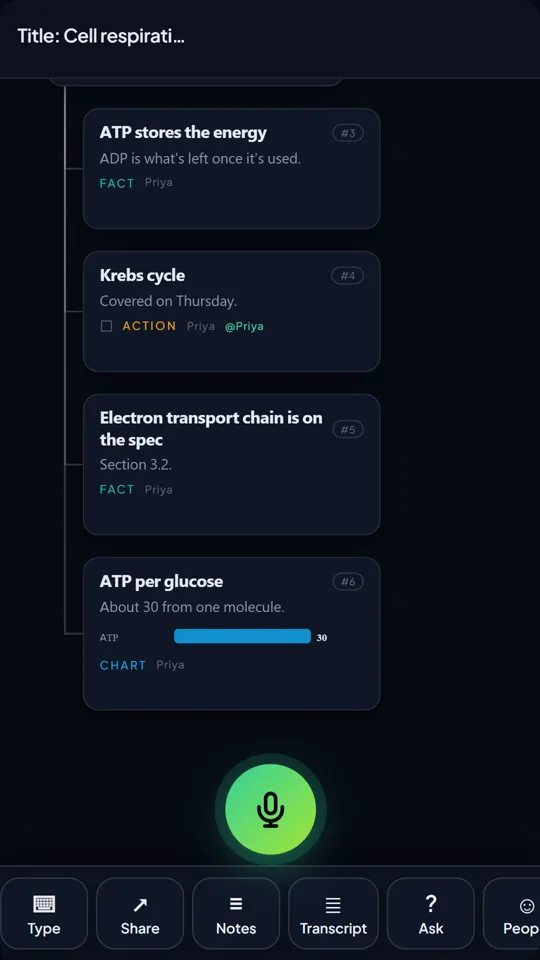
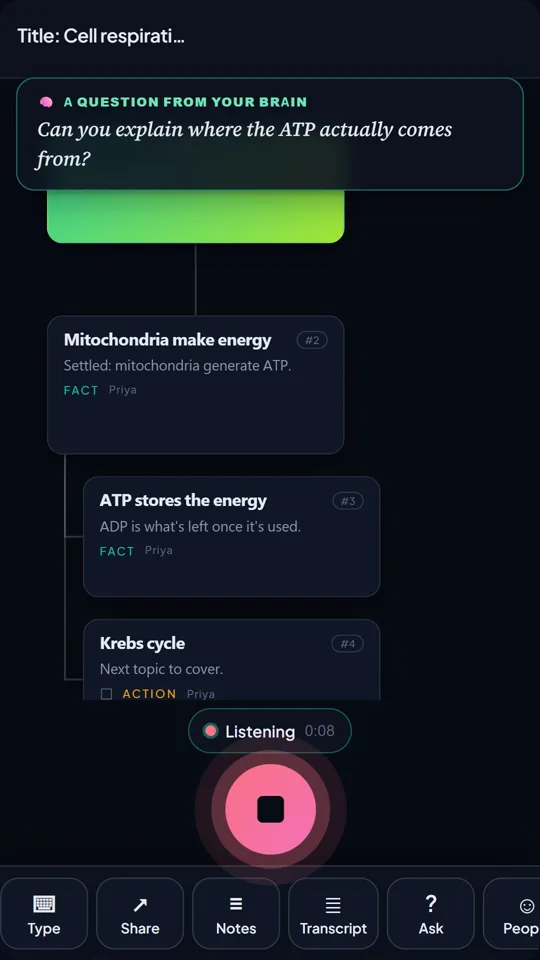
Map a topic, then collapse its branches and recall what's under each one before you open it. Or explain the topic out loud from memory into a new map and compare it with your notes.
Every map also feeds your Brain, where a 60-second workout asks you to say five of your ideas back from memory. Ideas you haven't revisited in a month fade until you do, so the spacing that the research recommends comes to you rather than relying on a revision timetable.
Tonight, close the book and talk through yesterday's lecture for three minutes. Then check your notes and circle the two things you left out.
Questions people ask
How often should I do active recall?
A good rhythm is the same day, a few days later and about a week later for each topic, then less often as it sticks. Spacing matters more than the exact days.
Is active recall better than making notes?
They do different jobs. Notes capture the material; recall is how you learn it. The best notes are ones you can test yourself with, like a question for each main idea.
Does highlighting help?
A major review of study techniques rated highlighting low, mainly because the evidence for it is thin. It's fine for finding things later, but it isn't a substitute for recall.
How long until active recall works?
You'll usually notice the difference within a week or two of regular practice, when topics you've recalled a few times come back much more easily.
TalkGraph maps what you say as you speak and asks you the next question. Free to try, no sign-up.

Klevis is the founder of TalkGraph, which he built and shipped solo. He has a First Class MSc in Computing and Information Systems, and writes about thinking, learning and tools that help people think rather than think for them.
LinkedIn →Sources
- Roediger, H. L. & Karpicke, J. D. (2006). Test-enhanced learning: Taking memory tests improves long-term retention. Psychological Science, 17(3), 249-255. doi.org/10.1111/j.1467-9280.2006.01693.x
- Dunlosky, J. et al. (2013). Improving students' learning with effective learning techniques. Psychological Science in the Public Interest, 14(1), 4-58. doi.org/10.1177/1529100612453266